Dependency Olarak Class'lar
🌐 Translation by AI and humans
This translation was made by AI guided by humans. 🤝
It could have mistakes of misunderstanding the original meaning, or looking unnatural, etc. 🤖
You can improve this translation by helping us guide the AI LLM better.
Dependency Injection sistemine daha derinlemesine geçmeden önce, bir önceki örneği geliştirelim.
Önceki Örnekten Bir dict
Önceki örnekte, dependency'mizden ("dependable") bir dict döndürüyorduk:
from typing import Annotated

from fastapi import Depends, FastAPI

app = FastAPI()


async def common_parameters(q: str | None = None, skip: int = 0, limit: int = 100):
    return {"q": q, "skip": skip, "limit": limit}


@app.get("/items/")
async def read_items(commons: Annotated[dict, Depends(common_parameters)]):
    return commons


@app.get("/users/")
async def read_users(commons: Annotated[dict, Depends(common_parameters)]):
    return commons
🤓 Other versions and variants
from typing import Annotated, Union

from fastapi import Depends, FastAPI

app = FastAPI()


async def common_parameters(
    q: Union[str, None] = None, skip: int = 0, limit: int = 100
):
    return {"q": q, "skip": skip, "limit": limit}


@app.get("/items/")
async def read_items(commons: Annotated[dict, Depends(common_parameters)]):
    return commons


@app.get("/users/")
async def read_users(commons: Annotated[dict, Depends(common_parameters)]):
    return commons
Tip
Prefer to use the Annotated version if possible.
from fastapi import Depends, FastAPI

app = FastAPI()


async def common_parameters(q: str | None = None, skip: int = 0, limit: int = 100):
    return {"q": q, "skip": skip, "limit": limit}


@app.get("/items/")
async def read_items(commons: dict = Depends(common_parameters)):
    return commons


@app.get("/users/")
async def read_users(commons: dict = Depends(common_parameters)):
    return commons
Tip
Prefer to use the Annotated version if possible.
from typing import Union

from fastapi import Depends, FastAPI

app = FastAPI()


async def common_parameters(
    q: Union[str, None] = None, skip: int = 0, limit: int = 100
):
    return {"q": q, "skip": skip, "limit": limit}


@app.get("/items/")
async def read_items(commons: dict = Depends(common_parameters)):
    return commons


@app.get("/users/")
async def read_users(commons: dict = Depends(common_parameters)):
    return commons
Ama sonra path operation function içindeki commons parametresinde bir dict alıyoruz.
Ve biliyoruz ki editor'ler dict'ler için çok fazla destek (ör. completion) veremez; çünkü key'lerini ve value type'larını bilemezler.
Daha iyisini yapabiliriz...
Bir Şeyi Dependency Yapan Nedir
Şimdiye kadar dependency'leri function olarak tanımlanmış şekilde gördünüz.
Ancak dependency tanımlamanın tek yolu bu değil (muhtemelen en yaygını bu olsa da).
Buradaki kritik nokta, bir dependency'nin "callable" olması gerektiğidir.
Python'da "callable", Python'ın bir function gibi "çağırabildiği" her şeydir.
Yani elinizde something adlı bir nesne varsa (function olmak zorunda değil) ve onu şöyle "çağırabiliyorsanız" (çalıştırabiliyorsanız):
something()
veya
something(some_argument, some_keyword_argument="foo")
o zaman bu bir "callable" demektir.
Dependency Olarak Class'lar
Python'da bir class'tan instance oluştururken de aynı söz dizimini kullandığınızı fark etmiş olabilirsiniz.
Örneğin:
class Cat:
    def __init__(self, name: str):
        self.name = name


fluffy = Cat(name="Mr Fluffy")
Bu durumda fluffy, Cat class'ının bir instance'ıdır.
Ve fluffy oluşturmak için Cat'i "çağırmış" olursunuz.
Dolayısıyla bir Python class'ı da bir callable'dır.
O zaman FastAPI içinde bir Python class'ını dependency olarak kullanabilirsiniz.
FastAPI'nin aslında kontrol ettiği şey, bunun bir "callable" olması (function, class ya da başka bir şey) ve tanımlı parametreleridir.
Eğer FastAPI'de bir dependency olarak bir "callable" verirseniz, FastAPI o "callable" için parametreleri analiz eder ve bunları path operation function parametreleriyle aynı şekilde işler. Sub-dependency'ler dahil.
Bu, hiç parametresi olmayan callable'lar için de geçerlidir. Tıpkı hiç parametresi olmayan path operation function'larda olduğu gibi.
O zaman yukarıdaki common_parameters adlı "dependable" dependency'sini CommonQueryParams class'ına çevirebiliriz:
from typing import Annotated

from fastapi import Depends, FastAPI

app = FastAPI()


fake_items_db = [{"item_name": "Foo"}, {"item_name": "Bar"}, {"item_name": "Baz"}]


class CommonQueryParams:
    def __init__(self, q: str | None = None, skip: int = 0, limit: int = 100):
        self.q = q
        self.skip = skip
        self.limit = limit


@app.get("/items/")
async def read_items(commons: Annotated[CommonQueryParams, Depends(CommonQueryParams)]):
    response = {}
    if commons.q:
        response.update({"q": commons.q})
    items = fake_items_db[commons.skip : commons.skip + commons.limit]
    response.update({"items": items})
    return response
🤓 Other versions and variants
from typing import Annotated, Union

from fastapi import Depends, FastAPI

app = FastAPI()


fake_items_db = [{"item_name": "Foo"}, {"item_name": "Bar"}, {"item_name": "Baz"}]


class CommonQueryParams:
    def __init__(self, q: Union[str, None] = None, skip: int = 0, limit: int = 100):
        self.q = q
        self.skip = skip
        self.limit = limit


@app.get("/items/")
async def read_items(commons: Annotated[CommonQueryParams, Depends(CommonQueryParams)]):
    response = {}
    if commons.q:
        response.update({"q": commons.q})
    items = fake_items_db[commons.skip : commons.skip + commons.limit]
    response.update({"items": items})
    return response
Tip
Prefer to use the Annotated version if possible.
from fastapi import Depends, FastAPI

app = FastAPI()


fake_items_db = [{"item_name": "Foo"}, {"item_name": "Bar"}, {"item_name": "Baz"}]


class CommonQueryParams:
    def __init__(self, q: str | None = None, skip: int = 0, limit: int = 100):
        self.q = q
        self.skip = skip
        self.limit = limit


@app.get("/items/")
async def read_items(commons: CommonQueryParams = Depends(CommonQueryParams)):
    response = {}
    if commons.q:
        response.update({"q": commons.q})
    items = fake_items_db[commons.skip : commons.skip + commons.limit]
    response.update({"items": items})
    return response
Tip
Prefer to use the Annotated version if possible.
from typing import Union

from fastapi import Depends, FastAPI

app = FastAPI()


fake_items_db = [{"item_name": "Foo"}, {"item_name": "Bar"}, {"item_name": "Baz"}]


class CommonQueryParams:
    def __init__(self, q: Union[str, None] = None, skip: int = 0, limit: int = 100):
        self.q = q
        self.skip = skip
        self.limit = limit


@app.get("/items/")
async def read_items(commons: CommonQueryParams = Depends(CommonQueryParams)):
    response = {}
    if commons.q:
        response.update({"q": commons.q})
    items = fake_items_db[commons.skip : commons.skip + commons.limit]
    response.update({"items": items})
    return response
Class instance'ını oluşturmak için kullanılan __init__ metoduna dikkat edin:
from typing import Annotated

from fastapi import Depends, FastAPI

app = FastAPI()


fake_items_db = [{"item_name": "Foo"}, {"item_name": "Bar"}, {"item_name": "Baz"}]


class CommonQueryParams:
    def __init__(self, q: str | None = None, skip: int = 0, limit: int = 100):
        self.q = q
        self.skip = skip
        self.limit = limit


@app.get("/items/")
async def read_items(commons: Annotated[CommonQueryParams, Depends(CommonQueryParams)]):
    response = {}
    if commons.q:
        response.update({"q": commons.q})
    items = fake_items_db[commons.skip : commons.skip + commons.limit]
    response.update({"items": items})
    return response
🤓 Other versions and variants
from typing import Annotated, Union

from fastapi import Depends, FastAPI

app = FastAPI()


fake_items_db = [{"item_name": "Foo"}, {"item_name": "Bar"}, {"item_name": "Baz"}]


class CommonQueryParams:
    def __init__(self, q: Union[str, None] = None, skip: int = 0, limit: int = 100):
        self.q = q
        self.skip = skip
        self.limit = limit


@app.get("/items/")
async def read_items(commons: Annotated[CommonQueryParams, Depends(CommonQueryParams)]):
    response = {}
    if commons.q:
        response.update({"q": commons.q})
    items = fake_items_db[commons.skip : commons.skip + commons.limit]
    response.update({"items": items})
    return response
Tip
Prefer to use the Annotated version if possible.
from fastapi import Depends, FastAPI

app = FastAPI()


fake_items_db = [{"item_name": "Foo"}, {"item_name": "Bar"}, {"item_name": "Baz"}]


class CommonQueryParams:
    def __init__(self, q: str | None = None, skip: int = 0, limit: int = 100):
        self.q = q
        self.skip = skip
        self.limit = limit


@app.get("/items/")
async def read_items(commons: CommonQueryParams = Depends(CommonQueryParams)):
    response = {}
    if commons.q:
        response.update({"q": commons.q})
    items = fake_items_db[commons.skip : commons.skip + commons.limit]
    response.update({"items": items})
    return response
Tip
Prefer to use the Annotated version if possible.
from typing import Union

from fastapi import Depends, FastAPI

app = FastAPI()


fake_items_db = [{"item_name": "Foo"}, {"item_name": "Bar"}, {"item_name": "Baz"}]


class CommonQueryParams:
    def __init__(self, q: Union[str, None] = None, skip: int = 0, limit: int = 100):
        self.q = q
        self.skip = skip
        self.limit = limit


@app.get("/items/")
async def read_items(commons: CommonQueryParams = Depends(CommonQueryParams)):
    response = {}
    if commons.q:
        response.update({"q": commons.q})
    items = fake_items_db[commons.skip : commons.skip + commons.limit]
    response.update({"items": items})
    return response
...bizim önceki common_parameters ile aynı parametrelere sahip:
from typing import Annotated

from fastapi import Depends, FastAPI

app = FastAPI()


async def common_parameters(q: str | None = None, skip: int = 0, limit: int = 100):
    return {"q": q, "skip": skip, "limit": limit}


@app.get("/items/")
async def read_items(commons: Annotated[dict, Depends(common_parameters)]):
    return commons


@app.get("/users/")
async def read_users(commons: Annotated[dict, Depends(common_parameters)]):
    return commons
🤓 Other versions and variants
from typing import Annotated, Union

from fastapi import Depends, FastAPI

app = FastAPI()


async def common_parameters(
    q: Union[str, None] = None, skip: int = 0, limit: int = 100
):
    return {"q": q, "skip": skip, "limit": limit}


@app.get("/items/")
async def read_items(commons: Annotated[dict, Depends(common_parameters)]):
    return commons


@app.get("/users/")
async def read_users(commons: Annotated[dict, Depends(common_parameters)]):
    return commons
Tip
Prefer to use the Annotated version if possible.
from fastapi import Depends, FastAPI

app = FastAPI()


async def common_parameters(q: str | None = None, skip: int = 0, limit: int = 100):
    return {"q": q, "skip": skip, "limit": limit}


@app.get("/items/")
async def read_items(commons: dict = Depends(common_parameters)):
    return commons


@app.get("/users/")
async def read_users(commons: dict = Depends(common_parameters)):
    return commons
Tip
Prefer to use the Annotated version if possible.
from typing import Union

from fastapi import Depends, FastAPI

app = FastAPI()


async def common_parameters(
    q: Union[str, None] = None, skip: int = 0, limit: int = 100
):
    return {"q": q, "skip": skip, "limit": limit}


@app.get("/items/")
async def read_items(commons: dict = Depends(common_parameters)):
    return commons


@app.get("/users/")
async def read_users(commons: dict = Depends(common_parameters)):
    return commons
Bu parametreler, dependency'yi "çözmek" için FastAPI'nin kullanacağı şeylerdir.
Her iki durumda da şunlar olacak:
strolan opsiyonel birqquery parametresi.- Default değeri
0olaninttipinde birskipquery parametresi. - Default değeri
100olaninttipinde birlimitquery parametresi.
Her iki durumda da veriler dönüştürülecek, doğrulanacak, OpenAPI şemasında dokümante edilecek, vb.
Kullanalım
Artık bu class'ı kullanarak dependency'nizi tanımlayabilirsiniz.
from typing import Annotated

from fastapi import Depends, FastAPI

app = FastAPI()


fake_items_db = [{"item_name": "Foo"}, {"item_name": "Bar"}, {"item_name": "Baz"}]


class CommonQueryParams:
    def __init__(self, q: str | None = None, skip: int = 0, limit: int = 100):
        self.q = q
        self.skip = skip
        self.limit = limit


@app.get("/items/")
async def read_items(commons: Annotated[CommonQueryParams, Depends(CommonQueryParams)]):
    response = {}
    if commons.q:
        response.update({"q": commons.q})
    items = fake_items_db[commons.skip : commons.skip + commons.limit]
    response.update({"items": items})
    return response
🤓 Other versions and variants
from typing import Annotated, Union

from fastapi import Depends, FastAPI

app = FastAPI()


fake_items_db = [{"item_name": "Foo"}, {"item_name": "Bar"}, {"item_name": "Baz"}]


class CommonQueryParams:
    def __init__(self, q: Union[str, None] = None, skip: int = 0, limit: int = 100):
        self.q = q
        self.skip = skip
        self.limit = limit


@app.get("/items/")
async def read_items(commons: Annotated[CommonQueryParams, Depends(CommonQueryParams)]):
    response = {}
    if commons.q:
        response.update({"q": commons.q})
    items = fake_items_db[commons.skip : commons.skip + commons.limit]
    response.update({"items": items})
    return response
Tip
Prefer to use the Annotated version if possible.
from fastapi import Depends, FastAPI

app = FastAPI()


fake_items_db = [{"item_name": "Foo"}, {"item_name": "Bar"}, {"item_name": "Baz"}]


class CommonQueryParams:
    def __init__(self, q: str | None = None, skip: int = 0, limit: int = 100):
        self.q = q
        self.skip = skip
        self.limit = limit


@app.get("/items/")
async def read_items(commons: CommonQueryParams = Depends(CommonQueryParams)):
    response = {}
    if commons.q:
        response.update({"q": commons.q})
    items = fake_items_db[commons.skip : commons.skip + commons.limit]
    response.update({"items": items})
    return response
Tip
Prefer to use the Annotated version if possible.
from typing import Union

from fastapi import Depends, FastAPI

app = FastAPI()


fake_items_db = [{"item_name": "Foo"}, {"item_name": "Bar"}, {"item_name": "Baz"}]


class CommonQueryParams:
    def __init__(self, q: Union[str, None] = None, skip: int = 0, limit: int = 100):
        self.q = q
        self.skip = skip
        self.limit = limit


@app.get("/items/")
async def read_items(commons: CommonQueryParams = Depends(CommonQueryParams)):
    response = {}
    if commons.q:
        response.update({"q": commons.q})
    items = fake_items_db[commons.skip : commons.skip + commons.limit]
    response.update({"items": items})
    return response
FastAPI, CommonQueryParams class'ını çağırır. Bu, o class'ın bir "instance"ını oluşturur ve bu instance, sizin function'ınıza commons parametresi olarak geçirilir.
Type Annotation vs Depends
Yukarıdaki kodda CommonQueryParams'ı iki kez yazdığımıza dikkat edin:
commons: Annotated[CommonQueryParams, Depends(CommonQueryParams)]
İpucu
Mümkünse Annotated sürümünü kullanmayı tercih edin.
commons: CommonQueryParams = Depends(CommonQueryParams)
Şuradaki son CommonQueryParams:
... Depends(CommonQueryParams)
...FastAPI'nin dependency'nin ne olduğunu anlamak için gerçekten kullandığı şeydir.
FastAPI tanımlanan parametreleri buradan çıkarır ve aslında çağıracağı şey de budur.
Bu durumda, şuradaki ilk CommonQueryParams:
commons: Annotated[CommonQueryParams, ...
İpucu
Mümkünse Annotated sürümünü kullanmayı tercih edin.
commons: CommonQueryParams ...
...FastAPI için özel bir anlam taşımaz. FastAPI bunu veri dönüştürme, doğrulama vb. için kullanmaz (çünkü bunlar için Depends(CommonQueryParams) kullanıyor).
Hatta şunu bile yazabilirsiniz:
commons: Annotated[Any, Depends(CommonQueryParams)]
İpucu
Mümkünse Annotated sürümünü kullanmayı tercih edin.
commons = Depends(CommonQueryParams)
...şu örnekte olduğu gibi:
from typing import Annotated, Any

from fastapi import Depends, FastAPI

app = FastAPI()


fake_items_db = [{"item_name": "Foo"}, {"item_name": "Bar"}, {"item_name": "Baz"}]


class CommonQueryParams:
    def __init__(self, q: str | None = None, skip: int = 0, limit: int = 100):
        self.q = q
        self.skip = skip
        self.limit = limit


@app.get("/items/")
async def read_items(commons: Annotated[Any, Depends(CommonQueryParams)]):
    response = {}
    if commons.q:
        response.update({"q": commons.q})
    items = fake_items_db[commons.skip : commons.skip + commons.limit]
    response.update({"items": items})
    return response
🤓 Other versions and variants
from typing import Annotated, Any, Union

from fastapi import Depends, FastAPI

app = FastAPI()


fake_items_db = [{"item_name": "Foo"}, {"item_name": "Bar"}, {"item_name": "Baz"}]


class CommonQueryParams:
    def __init__(self, q: Union[str, None] = None, skip: int = 0, limit: int = 100):
        self.q = q
        self.skip = skip
        self.limit = limit


@app.get("/items/")
async def read_items(commons: Annotated[Any, Depends(CommonQueryParams)]):
    response = {}
    if commons.q:
        response.update({"q": commons.q})
    items = fake_items_db[commons.skip : commons.skip + commons.limit]
    response.update({"items": items})
    return response
Tip
Prefer to use the Annotated version if possible.
from fastapi import Depends, FastAPI

app = FastAPI()


fake_items_db = [{"item_name": "Foo"}, {"item_name": "Bar"}, {"item_name": "Baz"}]


class CommonQueryParams:
    def __init__(self, q: str | None = None, skip: int = 0, limit: int = 100):
        self.q = q
        self.skip = skip
        self.limit = limit


@app.get("/items/")
async def read_items(commons=Depends(CommonQueryParams)):
    response = {}
    if commons.q:
        response.update({"q": commons.q})
    items = fake_items_db[commons.skip : commons.skip + commons.limit]
    response.update({"items": items})
    return response
Tip
Prefer to use the Annotated version if possible.
from typing import Union

from fastapi import Depends, FastAPI

app = FastAPI()


fake_items_db = [{"item_name": "Foo"}, {"item_name": "Bar"}, {"item_name": "Baz"}]


class CommonQueryParams:
    def __init__(self, q: Union[str, None] = None, skip: int = 0, limit: int = 100):
        self.q = q
        self.skip = skip
        self.limit = limit


@app.get("/items/")
async def read_items(commons=Depends(CommonQueryParams)):
    response = {}
    if commons.q:
        response.update({"q": commons.q})
    items = fake_items_db[commons.skip : commons.skip + commons.limit]
    response.update({"items": items})
    return response
Ancak type'ı belirtmeniz önerilir; böylece editor'ünüz commons parametresine ne geçirileceğini bilir ve size code completion, type check'leri vb. konularda yardımcı olur:
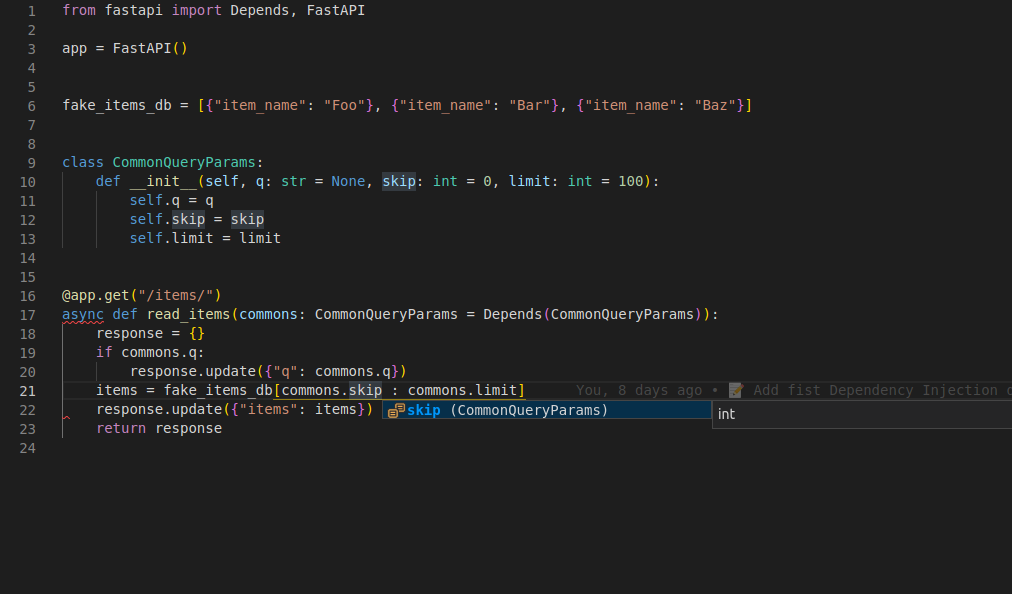
Kısayol
Ama burada bir miktar kod tekrarımız olduğunu görüyorsunuz; CommonQueryParams'ı iki kez yazıyoruz:
commons: Annotated[CommonQueryParams, Depends(CommonQueryParams)]
İpucu
Mümkünse Annotated sürümünü kullanmayı tercih edin.
commons: CommonQueryParams = Depends(CommonQueryParams)
FastAPI, bu durumlar için bir kısayol sağlar: dependency'nin özellikle FastAPI'nin bir instance oluşturmak için "çağıracağı" bir class olduğu durumlar.
Bu özel durumlarda şunu yapabilirsiniz:
Şunu yazmak yerine:
commons: Annotated[CommonQueryParams, Depends(CommonQueryParams)]
İpucu
Mümkünse Annotated sürümünü kullanmayı tercih edin.
commons: CommonQueryParams = Depends(CommonQueryParams)
...şunu yazarsınız:
commons: Annotated[CommonQueryParams, Depends()]
İpucu
Mümkünse Annotated sürümünü kullanmayı tercih edin.
commons: CommonQueryParams = Depends()
Dependency'yi parametrenin type'ı olarak tanımlarsınız ve Depends(CommonQueryParams) içinde class'ı yeniden yazmak yerine, parametre vermeden Depends() kullanırsınız.
Aynı örnek şu hale gelir:
from typing import Annotated

from fastapi import Depends, FastAPI

app = FastAPI()


fake_items_db = [{"item_name": "Foo"}, {"item_name": "Bar"}, {"item_name": "Baz"}]


class CommonQueryParams:
    def __init__(self, q: str | None = None, skip: int = 0, limit: int = 100):
        self.q = q
        self.skip = skip
        self.limit = limit


@app.get("/items/")
async def read_items(commons: Annotated[CommonQueryParams, Depends()]):
    response = {}
    if commons.q:
        response.update({"q": commons.q})
    items = fake_items_db[commons.skip : commons.skip + commons.limit]
    response.update({"items": items})
    return response
🤓 Other versions and variants
from typing import Annotated, Union

from fastapi import Depends, FastAPI

app = FastAPI()


fake_items_db = [{"item_name": "Foo"}, {"item_name": "Bar"}, {"item_name": "Baz"}]


class CommonQueryParams:
    def __init__(self, q: Union[str, None] = None, skip: int = 0, limit: int = 100):
        self.q = q
        self.skip = skip
        self.limit = limit


@app.get("/items/")
async def read_items(commons: Annotated[CommonQueryParams, Depends()]):
    response = {}
    if commons.q:
        response.update({"q": commons.q})
    items = fake_items_db[commons.skip : commons.skip + commons.limit]
    response.update({"items": items})
    return response
Tip
Prefer to use the Annotated version if possible.
from fastapi import Depends, FastAPI

app = FastAPI()


fake_items_db = [{"item_name": "Foo"}, {"item_name": "Bar"}, {"item_name": "Baz"}]


class CommonQueryParams:
    def __init__(self, q: str | None = None, skip: int = 0, limit: int = 100):
        self.q = q
        self.skip = skip
        self.limit = limit


@app.get("/items/")
async def read_items(commons: CommonQueryParams = Depends()):
    response = {}
    if commons.q:
        response.update({"q": commons.q})
    items = fake_items_db[commons.skip : commons.skip + commons.limit]
    response.update({"items": items})
    return response
Tip
Prefer to use the Annotated version if possible.
from typing import Union

from fastapi import Depends, FastAPI

app = FastAPI()


fake_items_db = [{"item_name": "Foo"}, {"item_name": "Bar"}, {"item_name": "Baz"}]


class CommonQueryParams:
    def __init__(self, q: Union[str, None] = None, skip: int = 0, limit: int = 100):
        self.q = q
        self.skip = skip
        self.limit = limit


@app.get("/items/")
async def read_items(commons: CommonQueryParams = Depends()):
    response = {}
    if commons.q:
        response.update({"q": commons.q})
    items = fake_items_db[commons.skip : commons.skip + commons.limit]
    response.update({"items": items})
    return response
...ve FastAPI ne yapması gerektiğini bilir.
İpucu
Bu size faydalı olmaktan çok kafa karıştırıcı geliyorsa, kullanmayın; buna ihtiyacınız yok.
Bu sadece bir kısayoldur. Çünkü FastAPI kod tekrarını en aza indirmenize yardımcı olmayı önemser.